Wall position selection for preserved moss displays
Wall position selection for preserved moss displays is the process of evaluating a room's physical and visual conditions to determine where a moss panel or arrangement will remain stable, visible, and structurally supported over time. It depends on wall construction, exposure to moisture and light, room function, and the viewing distance from which the piece is seen. The main considerations fall into three categories: structural suitability of the wall surface, environmental factors that affect preserved moss, and the visual role the piece plays in the room. This article describes how each factor influences placement and how they combine to produce a durable and visually coherent installation.
Structural factors
The wall itself must be able to hold the weight of a moss panel or frame. Preserved moss is lightweight compared to live plants or stone, but a large assembled piece can still weigh several kilograms once the backing board, wood frame, and hanging hardware are added. Drywall without a stud behind it can support only limited weight, especially if the moss panel is deep or framed with thick timber. Masonry walls and plaster over brick offer stronger anchors, but drilling into them requires masonry bits and appropriate wall plugs. The type of hanging hardware should match the wall material: toggle bolts for hollow drywall, expansion anchors for concrete, and molly bolts for plaster.
The surface flatness of the wall also matters. Moss panels are often mounted flush against the wall, so any significant unevenness can cause the frame to rock or the moss to pull away from the backing. A wall that has been skim-coated or has a consistent natural wall texture for rooms will provide a better mounting surface than one with heavy orange-peel or knockdown texture, though minor texture can be compensated with adhesive felt pads behind the frame. The orientation of the wall itself, whether it is an interior partition, an exterior wall, or a wall adjacent to a bathroom or kitchen, determines how much temperature swing and moisture the moss will experience.
Environmental conditions
Preserved moss is no longer alive, but it remains sensitive to its surroundings. High humidity causes the glycerin-based preservation solution to weep or attract mold, while direct sunlight bleaches the natural green tones over weeks or months. The ideal wall position avoids both extremes. Exterior walls in cold climates can develop condensation inside the wall cavity during winter, which may migrate through the paint and affect the moss backing. Walls near a radiator, fireplace, or heating vent should be avoided because the dry heat accelerates brittleness in the moss fronds. Similarly, a wall that receives strong afternoon sun through a window will cause uneven fading on the side of the panel that faces the light.
Natural light should be indirect and diffuse. A wall opposite a north-facing window in the northern hemisphere, or south-facing in the southern hemisphere, provides the most stable light for color retention. If the room has only east or west windows, the moss should be placed on the wall that is parallel to the window rather than directly facing it, so that the light grazes the surface rather than striking it head-on. Artificial lighting, such as track lights or picture lights, can be used to highlight the texture of the moss, but the fixture should be LED and placed at least 30 centimeters from the moss surface to avoid heat buildup.
Visual balance and room scale
The wall position also determines how the moss piece relates to the rest of the room. A large moss panel on a small wall can overwhelm the space, while a small piece on a large empty wall may look lost. The principle of room scale suggests that the moss piece should occupy roughly one-third to one-half of the wall's width, though this varies with ceiling height and the presence of other furniture. A common approach is to center the moss panel on the wall at eye level, which is approximately 145 to 155 centimeters from the floor, measured to the center of the piece. This height aligns with the average viewing angle of a standing adult and places the moss where it can be seen without craning the neck.
In rooms where the moss is part of a gallery wall, the position of each piece must relate to the others. The moss panel often serves as the anchor because of its organic texture and deep green color, which contrasts with framed prints or photographs. The wall color behind the moss affects how prominent the piece appears. A light wall makes the moss stand out, while a dark wall absorbs some of the contrast and can make the moss recede. The choice of wall color should consider whether the moss is meant to be a focal point or a subtle background element. When the moss is intended as a focal point, the wall position should be the first surface seen when entering the room, such as the wall opposite the door or the wall behind a sofa or bed.
Functional zones of the room
Different areas of a room have different functional demands. In a living room, the wall above the sofa is a natural location for a moss panel, but the piece should be mounted high enough that seated occupants do not brush against it. A clearance of 15 to 20 centimeters above the backrest is standard. In a bedroom, the wall behind the headboard works well, though the moss should be secured with extra care because the headboard may be moved during bed-making. In a home office, the wall facing the desk can provide a calming visual break, but the moss should not be placed where it reflects glare from a monitor screen.
In hallways and entryways, the wall position must account for traffic flow. A moss panel should not protrude into the walking path, and it should be mounted securely enough to withstand occasional bumps from bags or shoulders. Narrow hallways benefit from a vertically oriented moss piece that draws the eye upward and makes the space feel taller. In rooms with low ceilings, a horizontal moss panel can visually widen the space, but it should be placed above furniture rather than at the midpoint of the wall to avoid cutting the room in half.
Moisture-prone areas
Bathrooms and kitchens present the greatest risk for preserved moss. Steam from showers and cooking raises the humidity level in the air, which can cause the moss to become limp or develop a musty odor. If a moss piece is desired in a bathroom, it should be placed on a wall that is farthest from the shower or bathtub, and the room should have an exhaust fan that is run during and after bathing. A kitchen moss panel should be installed away from the stove and sink, ideally on a wall that does not receive steam from boiling pots. In both cases, the backing board should be sealed with a moisture-resistant coating, and the wood frame should be treated with a waterproof sealant.
The wall material in these rooms also matters. Tile walls are difficult to drill into without cracking the tile, and the grout lines may not provide a stable anchor. A better option is to mount the moss on a section of wall that is painted drywall, if such a section exists. If the entire bathroom is tiled, a moss piece can be mounted using adhesive hooks rated for tile, but the weight limit of such hooks is low, so only small panels are feasible. For larger pieces, a professional installer should assess the wall structure and recommend a mounting method that does not damage the tile.
When a moss panel is placed in a room with consistent humidity and temperature, the preserved moss can retain its color and flexibility for several years. The wall position that achieves this stability is one that avoids direct sunlight, heating vents, air conditioning drafts, and moisture sources. A wall that is interior, shaded, and away from the kitchen and bathroom is the safest choice. The presence of a natural wall texture for rooms on that wall can help the moss blend in naturally, but the texture should not be so deep that it prevents the frame from sitting flush.
Combining multiple panels
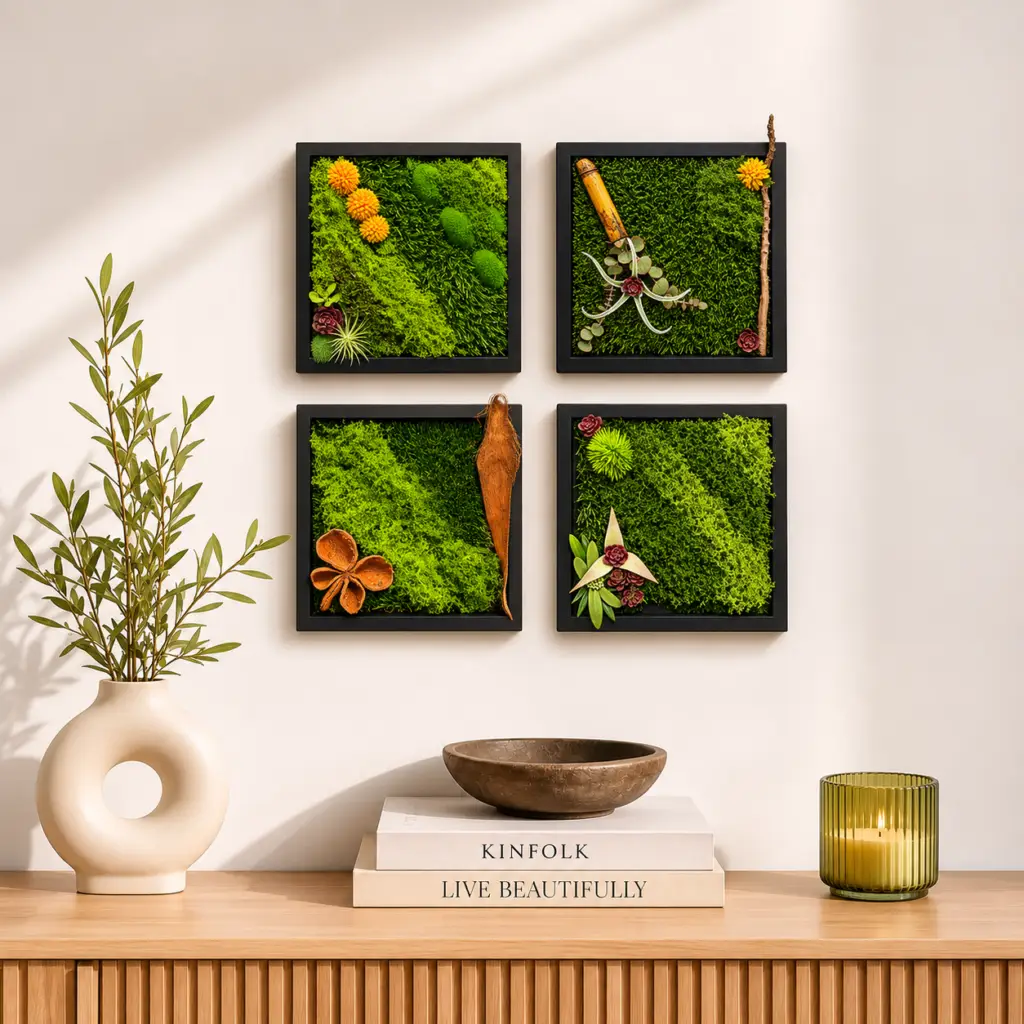
When a room calls for more than one moss panel, the positions of the panels must be planned as a group. A common arrangement is a grid of two or four equally sized panels spaced evenly across a wall. The spacing between panels should be uniform, typically 5 to 10 centimeters, to create a clean modern look. Another arrangement is an asymmetric cluster, where panels of different sizes are grouped at varying heights to create a more organic composition. In either case, the center of the group should be at eye level, and the outermost edges of the group should leave at least 15 centimeters of breathing room between the panels and the corners of the wall.
The relationship between the panels and the furniture below them follows the same rules as a single panel. A sofa, console table, or bed provides a visual base, so the bottom edge of the lowest panel should be 15 to 25 centimeters above the furniture. If the furniture is tall, such as a high headboard, the panels can be mounted slightly higher to keep the composition balanced. The wall color behind the group should be consistent, and any electrical outlets or light switches on that wall should be incorporated into the layout rather than covered by the panels.
Long-term maintenance access
Moss panels require occasional light dusting and, in some cases, re-misting with a preservation solution. The wall position should allow easy access to the front of the panel without requiring the removal of nearby furniture. A panel mounted above a tall bookshelf may be difficult to reach for cleaning, and a panel in a corner may accumulate dust on the side facing the adjacent wall. The hanging hardware should be accessible in case the panel needs to be taken down for more thorough cleaning or for replacement of the moss. A simple French cleat system allows the panel to be lifted off the wall without tools, while a keyhole bracket requires a screwdriver. The choice of hardware affects how easy it is to service the piece over its lifetime.
The wall position also determines how visible the edges of the moss panel are. If the panel is mounted flush against the wall, any gap between the frame and the wall should be sealed with a thin bead of caulk or covered with a trim piece. This prevents dust from accumulating behind the panel and keeps the installation looking finished. On textured walls, the caulk should match the wall color so that it blends with the natural wall texture for rooms rather than creating a visible seam.

Variations by room type
Each room type imposes its own constraints on wall position. In open-plan living areas, the moss panel may be visible from multiple angles, so its position should be chosen to look balanced from the main seating area, the dining area, and the kitchen. In a home office, the panel should be placed where it can be seen during short breaks without requiring the user to turn away from the desk entirely. In a child's room, the moss should be mounted high enough that it cannot be touched from the floor, and the hardware should be childproof. In a commercial space such as a lobby or waiting room, the wall position should align with the sightline of someone entering the room, and the panel should be large enough to be noticed from a distance.
The choice of wall position for preserved moss is ultimately a balance between structural feasibility, environmental stability, and visual intent. A position that works in one room may fail in another because of differences in light, humidity, or wall construction. By evaluating each of these factors before mounting, the installer can place the moss where it will remain attractive and intact for the longest possible time.
