Aerial Crop Spraying: What It Really Means for Modern Farms
I remember the first time I watched a drone work a wheat field. It was a warm June morning, and the farmer next to me was checking his phone, not for calls, but to watch the spray pattern unfold in real time. That moment stuck with me because it showed how far farming has come from the days of backpack sprayers and tractor booms. Aerial crop spraying is no longer a novelty or a distant promise. It is a working tool, and for many growers it is becoming the most sensible option on the table.
The idea of using aircraft for farm work is not new. Helicopters and fixed-wing planes have been spraying large fields for decades, especially in places like the United States and Australia. But the equipment has always been heavy, expensive, and limited to big operations. What changed in the last ten years is the arrival of agricultural drones. These Unmanned Aerial Vehicles have brought aerial application down to a scale that fits a typical British farm, and they do it with a level of precision that older machines simply cannot match.
Where aerial spraying fits on a farm
Not every field needs a drone. If you are working flat, open ground and the weather is calm, a tractor-mounted boom may still be the cheapest way to cover a large area. The real value of aerial crop spraying shows up when the ground is wet, the crop is tall, or the field is awkwardly shaped. I have seen fields with steep slopes that a tractor can barely climb, and corners where a boom leaves strips of untreated crop. Drones handle those situations without crushing a single plant.
There is also the matter of timing. Pests and diseases do not wait for the ground to dry. When a crop needs treatment, it usually needs it within a narrow window. A drone can be out in the field within the hour, working the same day as the decision is made. That speed is not a luxury. In a wet spring, it can be the difference between saving a crop and losing a chunk of it.
Beyond spraying, the same platform can be used for fertiliser spreading and seed sowing. This is where the economics start to make sense for smaller holdings. Instead of buying a separate machine for each job, a farmer can use one drone with different attachments. The ability to switch between tasks quickly means the equipment is working more days of the year, which changes the cost per acre in a meaningful way.
The precision factor
Precision agriculture is about doing the right thing in the right place at the right time. Aerial crop spraying fits that idea perfectly because it allows for variable rate application. Instead of treating the whole field as one uniform block, the drone can adjust the amount of pesticide application based on a map of the actual crop condition. That map might come from remote sensing, which can be done by the same drone in a separate flight, or from satellite imagery that the farmer already has.
GPS guidance makes this possible. The drone knows exactly where it is, and the sprayer turns on and off automatically as it crosses field boundaries or skips over sensitive areas like watercourses. This is not just about saving money on agrochemicals. It is about reducing environmental impact. When you apply less chemical where it is not needed, you keep more of it out of the soil and water. That is a benefit that shows up beyond the farm gate.
I have spoken to agronomists who say the data from drone flights is as valuable as the spraying itself. A well-flown mission produces a record of where the product went, at what rate, and under what conditions. That record is useful for compliance, for planning next season, and for explaining to a neighbour or an inspector why a particular decision was made. It turns spraying from a chore into a measured, documented part of the farm system.
Regulations and practical reality
Anyone considering this technology has to deal with the rules, and the rules are still settling. In the UK, the Civil Aviation Authority (CAA) oversees drone operations. The key point is that agricultural flights, including spraying, are not the same as recreational flying. You need specific permissions and often a pilot with the right qualifications. The CAA regulations are strict about where you can fly, how heavy the drone can be, and what you can carry. It is not something you can do with a hobby drone and a spray bottle.
In the United States, the Federal Aviation Administration (FAA) has its own set of rules, which have been evolving to allow more commercial agricultural use. The FAA regulations require a remote pilot certificate and an airworthiness approval for the aircraft. That process can be slow, but it is also necessary. These are machines carrying chemicals, and safety has to come first.
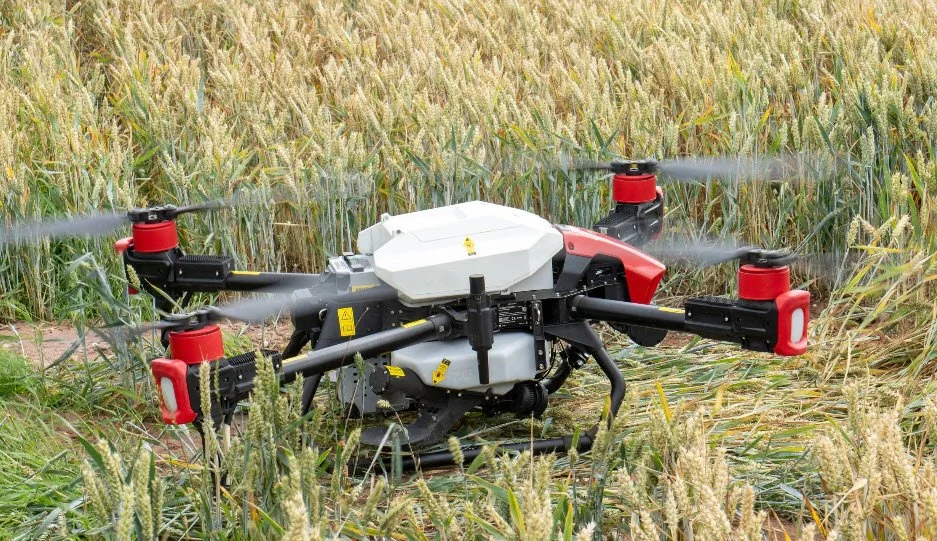
The equipment itself is worth understanding. The DJI Agras series is probably the most common sight in UK fields, and for good reason. It is built for the job, with a decent payload and a spray system designed for even coverage. The Yamaha RMax has been around much longer, originally developed for rice farms in Japan, and it is a proven workhorse. The choice between them often comes down to the size of the operation and the type of crops being treated. A large arable farm might want the bigger payload of the RMax, while a smaller mixed farm could manage perfectly well with an Agras.
The human side of the job
There is a learning curve with this technology, and it is not just about learning to fly. You have to understand the chemistry, the nozzle sizes, the droplet sizes, and how the weather affects drift. A drone is not a magic wand. It is a tool that demands the same careful thought as any other piece of spray equipment. The pilots I know who do this well spend as much time planning a flight as they do flying it. They check wind speed at different heights, they look at the crop stage, and they talk to the farmer about what the field actually needs.
That planning is what separates a professional operation from a toy. I have seen a poorly planned drone flight waste a tank of expensive product because the wind changed halfway through. I have also seen a well-timed flight save a field of oilseed rape from pod midge, where a tractor would have damaged the crop just by driving through it. The difference was not the drone. It was the person holding the controller.
There is also a question of trust. Farmers are rightly cautious about new technology, and they want to see it work before they commit. The best way to build that trust is to show results, and the results are often visible within days. A clean spray pattern, no missed strips, no damage to the crop, and a record of exactly what was done. That is a strong argument.
The bigger picture
Looking at the whole field of crop protection, aerial crop spraying is one part of a larger shift toward smarter, more responsive farming. It is not going to replace every tractor or every sprayer. But it is already changing the way many farms handle the jobs that are hard, dangerous, or just plain inefficient to do from the ground. The ability to go out when the ground is wet, to cover steep ground, to treat small patches precisely, and to do it all with less chemical adds up to a real advantage.
There are still limits. Battery life is one. A drone can only carry so much battery, which limits both flight time and payload. That means large fields still need multiple reloads, which takes time. The cost of the equipment is another factor. A good agricultural drone with all the accessories is a serious investment. But for many farms, the savings in chemical use, the reduction in crop damage, and the flexibility of being able to do both spraying and seed sowing are enough to make the numbers work.
What strikes me most is how quickly this has become normal. A few years ago, a drone over a field was a curiosity. Now it is just another tool in the shed, like a sprayer or a drill. The technology is still improving, but the fundamentals are already proven. Aerial crop spraying is here to stay, and it will only become more common as the equipment gets cheaper and the regulations catch up with the reality on the ground.
